The Great Acceleration: From 20 Minutes to 48 Hours — Redefining the Architecture of Autonomy in Finance

The landscape of quantitative finance is not merely changing; it is undergoing a tectonic shift of such magnitude that the very vocabulary of the industry is being rewritten. For decades, the "Quant" reigned supreme—a figure of intellectual prowess, armed with a Ph.D. from an Ivy League institution and the ability to translate the chaotic language of markets into the precise syntax of C++ or Python. But as we stand in the midst of the AI revolution, that era is rapidly drawing to a close. We are witnessing the birth of the AI Trading Agent System, a paradigm where the human element is no longer the engine of creation, but the architect of its constraints.
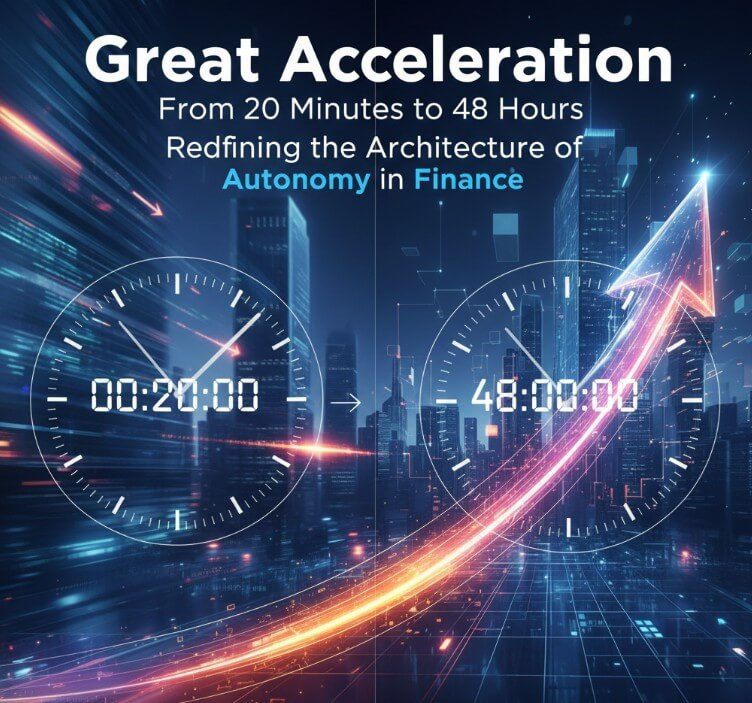
Recent discussions within the forefront of this technological wave have highlighted a crucial dichotomy. On one side, we have the validation of the vision: a fully autonomous pipeline that compresses weeks of human labor into minutes. On the other, we have the stark reality of the metrics that define success in this new world—metrics provided by industry leaders like the CEO of AlgoXpert, who are already living in the future the rest of the industry is scrambling to understand.
This post explores the intersection of these insights, diving deep into the architecture of autonomy, the compounding advantages of AI-native infrastructure, and the brutal efficiency of a system that can kill 99.9% of its own ideas to find the 0.1% that survive.
Part 1: The Vision Validated — The Architecture of Constraints to Greater Acceleration
The journey into autonomous trading begins with a fundamental shift in philosophy. As one observer noted, "This aligns perfectly with the future I envision for autonomy in trading." But the insight that follows is the key to unlocking the true potential of these systems: "Understanding the architectural constraints can significantly enhance how we leverage these AI agents. It's all about thoughtful design."
In the traditional model of quantitative finance, constraints were often viewed as limitations—regulatory hurdles, capital restrictions, or the latency of execution. However, in the age of the AI Trading Agent, constraints are the very essence of success.
The Orchestrator-Worker Pattern
The "Advanced Trading Agents" system represents the pinnacle of this thoughtful design. It does not simply ask an AI to "trade." It constructs a rigid, four-phase pipeline—an "orchestrator-worker" architecture—that forces the AI to adhere to a disciplined workflow.
The Sensory Apparatus (Phase 1): The system deploys specialized agents to gather intelligence. This is not a chaotic scrape of the web; it is a targeted ingestion of data across five distinct market verticals: Blockchain, Commodities, Forex, Treasuries, and Broad Markets. The constraint here is scope. By limiting the agents to specific verticals, the system ensures deep, relevant analysis rather than superficial breadth.
The Synthesis Engine (Phase 2): Raw data is useless without context. Here, the system transforms thousands of headlines into a 20,000-word intelligence document. The constraint is format—forcing the AI to synthesize disparate data points into a cohesive narrative.
The Code Factory (Phase 3): This is where the magic happens. The system utilizes GPT-5.3-Codex to generate executable Python scripts. The constraint is determinism. By using a lower temperature setting (0.3), the system ensures that the code is syntactically valid and logically sound, eliminating the "hallucinations" that plague generic AI interactions.
Deployment & Simulation (Phase 4): Finally, the bots are deployed in a simulated environment. The constraint is risk. No capital is risked until the strategy proves itself in the digital wilderness of a simulation.
This architecture solves the fundamental problem of AI in high-stakes environments: reliability. An unconstrained AI is a liability; a constrained AI, operating within a thoughtful architectural framework, is a powerful engine of alpha generation.
Part 2: The AlgoXpert Reality — Speed, Scale, and Survival
While the theoretical frameworks and initial deployments of systems like the "Advanced Trading Agents" are impressive, the comments from the CEO of AlgoXpert provide a chillingly precise snapshot of where the industry is actually heading. The statistics are not just impressive; they are a wake-up call.
"30% and accelerating. The firms that build AI-native R&D infrastructure now get a compounding advantage. We've been building exactly this — an agentic AI system that compresses quant R&D from 9 months to 48 hours. 300+ strategy candidates per cycle, 99.9% killed by automated validation. The 0.1% that survive: Sharpe 3.15 live, 50+ days."
The Compression of Time
Let us pause to consider the magnitude of this compression. The traditional R&D cycle for a quantitative strategy is a grueling 9-month odyssey. It involves research, hypothesis formation, data cleaning, backtesting, forward testing, and finally, deployment. In this traditional model, a single failure can set a team back by months.
AlgoXpert’s system compresses this to 48 hours. This is not an incremental improvement; it is a total displacement of the traditional timeline. It implies that in the time it takes a traditional team to hold their first strategy meeting, an AI-native firm has already iterated through hundreds of strategies, failed, learned, and deployed a survivor. This is the benfit to the greater acceleration.
The Brutality of Automated Validation
Perhaps the most striking aspect of the AlgoXpert insight is the validation rate: "300+ strategy candidates per cycle, 99.9% killed by automated validation."
Human traders are emotionally attached to their ideas. A quant developer who spends three weeks coding a strategy based on a "gut feeling" will often subconsciously ignore signals that contradict their hypothesis. They will tweak parameters to force a backtest to look good. This is survivorship bias in action, and it is a fatal flaw in human-led R&D.
The AI agent has no ego. It generates 300 candidates and ruthlessly executes 99.9% of them. This is the "fail fast" methodology taken to its logical extreme. The system does not mourn the loss of a strategy; it simply moves on to the next. This creates a funnel of extreme selection pressure. By the time a strategy reaches the "live" stage, it has survived a gauntlet of statistical torture that no human-designed strategy could endure.
The Quality of the Survivor
The result of this process is a strategy with a Sharpe Ratio of 3.15, live for over 50 days. In the world of finance, a Sharpe Ratio above 2 is considered excellent. Above 3 is the realm of the elite. The fact that an autonomous system is generating these results is a testament to the power of the "compounding advantage" mentioned by the CEO.
This compounding advantage works on two levels:
Data Compounding: Every backtest, every simulation, and every live trade feeds back into the system, refining the models.
Time Compounding: Because the cycle is 48 hours instead of 9 months, an AI-native firm can run roughly 180 iterations for every single iteration of a traditional firm. The gap in knowledge and optimization widens exponentially.
Part 3: The Economics of Displacement
The shift to AI Trading Agent Systems is not just a technological evolution; it is an economic revolution. The cost structures of the industry are being dismantled.
The Traditional Cost Model
A traditional hedge fund desk running strategies across multiple asset classes requires a small army of specialists:
Research Analysts: To scour news and reports.
Quant Researchers: To develop mathematical models.
Quant Developers: To code the strategies.
QA Engineers: To test the code.
Portfolio Managers: To oversee the execution.
The combined compensation for a team of 8 to 15 professionals ranges from 2millionto2 million to 2millionto5 million annually. This creates a high barrier to entry and puts immense pressure on the fund to generate massive returns just to cover operational costs.
The AI-Native Cost Model
The "Advanced Trading Agents" system, and similar architectures like AlgoXpert's, operate on a fundamentally different economic plane. The costs are limited to API usage (for the LLMs), cloud infrastructure, and data feeds.
Estimated annual operational cost: 20,000to20,000 to 20,000to50,000.
This represents a 98% reduction in operational costs.
For a small fund or an individual trader, this is democratizing. It levels the playing field, allowing a "Systematic Portfolio Manager" operating from a home office to deploy the same caliber of research and execution as a multi-billion dollar fund.
The Human Cost
We cannot ignore the implications for the workforce. As the "Advanced Trading Agents" report bluntly states: "Quant coding jobs are going to be done away with."
The roles of the "Research Analyst" and the "Quant Developer" are being absorbed into the automated pipeline. The AI gathers news faster than an analyst, writes code faster than a developer, and tests it with a consistency that humans cannot match.
However, this does not spell the end of human involvement. It necessitates a transformation. The human role shifts from "creator" to "orchestrator." The new skillset is not coding proficiency, but AI literacy and system design. The ability to define the constraints, select the models, and interpret the output becomes the primary leverage point.
As the AlgoXpert CEO noted, "Speed without discipline = faster failure." The human element is now the source of that discipline. We provide the guardrails; the AI provides the horsepower.
Part 4: The Future Roadmap — Options, MCP, and Autonomy
The current capabilities of these systems are merely the "early stages." The roadmap for the future points toward even greater complexity and autonomy.
Options Market Expansion
The "Advanced Trading Agents" report notes that "the real wealth is built in options." While futures strategies are linear, options strategies allow for complex payoff structures that profit from volatility and time decay.
The next generation of AI agents will not just generate trading bots; they will architect complex options spreads. They will analyze implied volatility surfaces and construct positions like "Iron Condors" or "Butterflies" that are mathematically optimized for the current market regime. This requires a leap in reasoning capability, as the number of variables in options pricing is exponentially higher than in simple directional futures trading.
MCP Server Integration
The Model Context Protocol (MCP) represents the next frontier in agent capability. Currently, agents rely heavily on news and price data. MCP servers will provide AI agents with real-time access to market microstructure data, historical backtesting results, and portfolio-level risk calculations.
Imagine an agent that can "see" the order book depth, the trade flow, and the historical correlation of an asset in real-time, all while reading the news. This holistic view will allow for strategies that are not just reactive, but predictive on a microstructural level.
The Question for 2026
The CEO of AlgoXpert poses the defining question for the near future: "The question for 2026 isn't 'should we use AI?' — it's 'how fast can we validate at scale?'"
By 2026, the adoption of AI in trading will be a given. The competitive edge will not come from having an AI system, but from the efficiency of the validation loop. Firms that can compress the R&D cycle from 48 hours to 4 hours will dominate. Firms that can process 3,000 strategy candidates instead of 300 will find the outliers that others miss.
Conclusion: The Era of the Systematic Portfolio Manager
We are living through the end of the traditional "Quant" as we know it. The labor-intensive, linear, and expensive model of strategy development is being replaced by the autonomous, parallel, and cheap model of the AI Trading Agent.
The insights from the field—ranging from the architectural constraints of the "Advanced Trading Agents" system to the ruthless efficiency of AlgoXpert's validation funnel—paint a clear picture. The future belongs to those who can design the machine, not those who turn the wrenches.
The new hero of this story is the Systematic Portfolio Manager. This individual is no longer a coder or an analyst. They are an architect. They understand the strengths and weaknesses of Claude 4.6 versus GPT-5.3-Codex. They know how to set the temperature to foster creativity in analysis and determinism in coding. They know that constraints are not limitations, but the very tools of success.
The technology is functional today. The adoption is accelerating. The cost advantages are undeniable. The only question remaining is: are you ready to orchestrate the future?
Frequently Asked Questions (FAQ)
What is an AI Trading Agent System? An AI Trading Agent System is an automated software pipeline that uses artificial intelligence to perform the functions of a trading team. This includes gathering market data, analyzing news, generating trading strategies, writing executable code, and deploying bots to trade financial instruments.
How does an AI Trading Agent differ from a trading bot? A traditional trading bot follows a pre-programmed set of rules created by a human. An AI Trading Agent creates the rules itself based on its analysis of real-time data. It can adapt its strategy to changing market conditions without human intervention.
Is AI trading profitable? The report indicates that these systems can generate viable strategies. However, profitability depends on the quality of the AI models, the data inputs, and the risk management parameters set by the human overseer. The system allows for rapid simulation testing to filter for profitable strategies before live deployment.
Will AI replace quantitative traders? The report suggests that AI will replace specific roles, such as "Quant Developer" and "Research Analyst." However, it creates a new role for "Systematic Portfolio Managers" who oversee and direct the AI systems. The human element shifts from coding to strategic oversight.
How much does it cost to run an AI Trading Agent System? The report estimates the annual cost of running such a system (primarily API usage and infrastructure) to be between 20,000and20,000 and 20,000and50,000, compared to $2–5 million for a traditional human team.
Disclaimer: This content is for informational purposes only and does not constitute financial advice. Trading involves risk of loss.

Comments